Conservation Heroes: A Year in the Life of Cousine Island’s Wildlife Team
There is no off-season on Cousine Island. The rhythms change, from moonlit turtle patrols on the beach to dawn bird counts in the canopy, but the work never stops. For more than 32 years, since Mr Keeley began a comprehensive rehabilitation programme in 1992, a small, dedicatedteam of conservation officers has kept watch over one of the most ecologically significant private islands in the Indian Ocean.
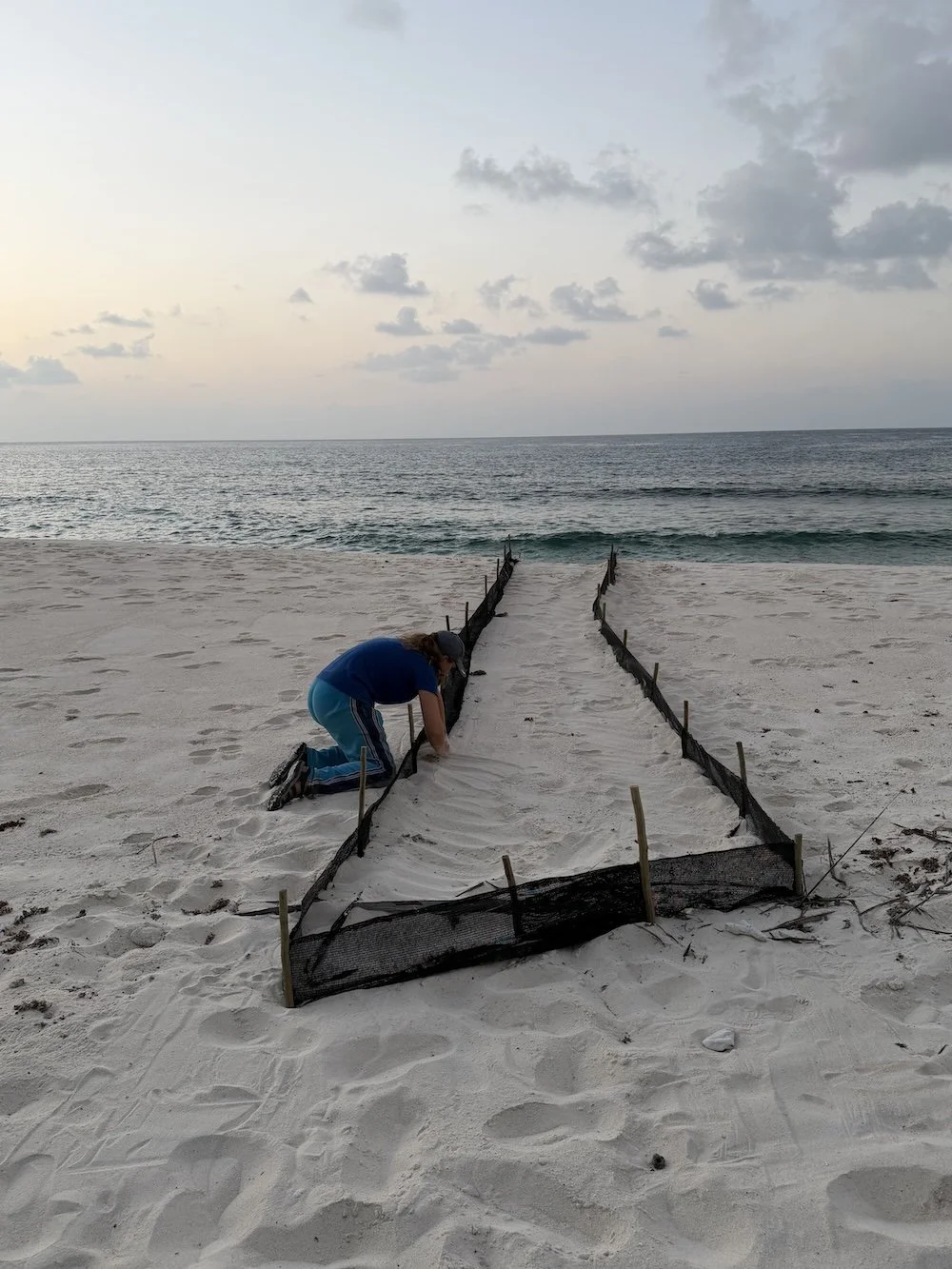
Conservation team member preparing hatchling release guide
As April arrives and the last turtle hatchlings of the season make their dash to the sea, the team’s attention is already shifting. The seabird colonies are building. The fairy terns are nesting. And a new chapter in Cousine Island’s ecological year is beginning.
Closing Out Turtle Season
The hawksbill and green turtles that nest on Cousine Island’s beaches arrive between September and February, with hatchlings emerging from December through April. By the time the winds shift in late March, the team has already recorded every nest, GPS-logged every emergence, and counted every hatchling that scrambled across the sand toward the water.
This season, like every season before it, required patience. The conservation officers walked the full length of the beach multiple times each night during peak nesting months, scanning for the distinctive tracks that indicate a female had come ashore. When they found one, they observed quietly from a distance, never interfering, but recording critical data: species, location, nest depth, and estimated clutch size. Each nest was then monitored until emergence.
April may bring the last few hatchlings of the year, a quiet, bittersweet close to a season that carries enormous emotional weight. Each hatchling that reaches the water represents a small but significant victory for a species under pressure from habitat loss, climate change, and ocean pollution worldwide. But for the team, there is no time to pause. The island’s next season is already underway.

Seabird colonies are monitored for health and success
The Seabird Colonies
A Different Kind of Spectacle
As turtle activity winds down, the skies above Cousine Island come alive. The island is home to nine species of seabirds, including fairy terns (800–1,000 breeding pairs), white-tailed tropicbirds (1,000 pairs), and lesser noddies (50,000–55,000 pairs). Fairy terns and white-tailed tropicbirds breed year-round on Cousine, but activity intensifies from April onward as conditions shift and the southeast trade winds begin to influence feeding patterns.
By May, the noddies and sooty terns arrive in force. At peak season, more than 100,000 seabirds are present on the island, a density that transforms the entire landscape. The conservation team monitors breeding success, nest locations, and population trends across all species, feeding data into an ecological record that now spans more than three decades.
For guests visiting in the coming months, this is the island at its most dramatic. The sound alone is unforgettable, tens of thousands of birds calling, circling, landing, feeding. A guided nature walk during seabird season is not just bird watching. It is standing inside one of the largest, most intact seabird colonies in the western Indian Ocean.
Beyond the Headlines
A Full Ecosystem Under Care
Turtles and seabirds may be the most visible elements of the conservation programme, but the team’s remit extends far beyond them. Cousine Island is a sanctuary for multiple endangered and endemic species. The Seychelles magpie-robin, once one of the rarest birds on Earth, now thrives here thanks to decades of habitat restoration. The Seychelles warbler, another species brought back from the brink of extinction, is regularly spotted in the canopy above the walking trails.
The island is also home to ten species of common land birds, Aldabra giant tortoises, geckos, skinks, and a rich marine ecosystem that includes whale sharks, reef sharks, and manta rays. The conservation team monitors all of it: population counts, breeding success rates, habitat health, invasive species surveillance.
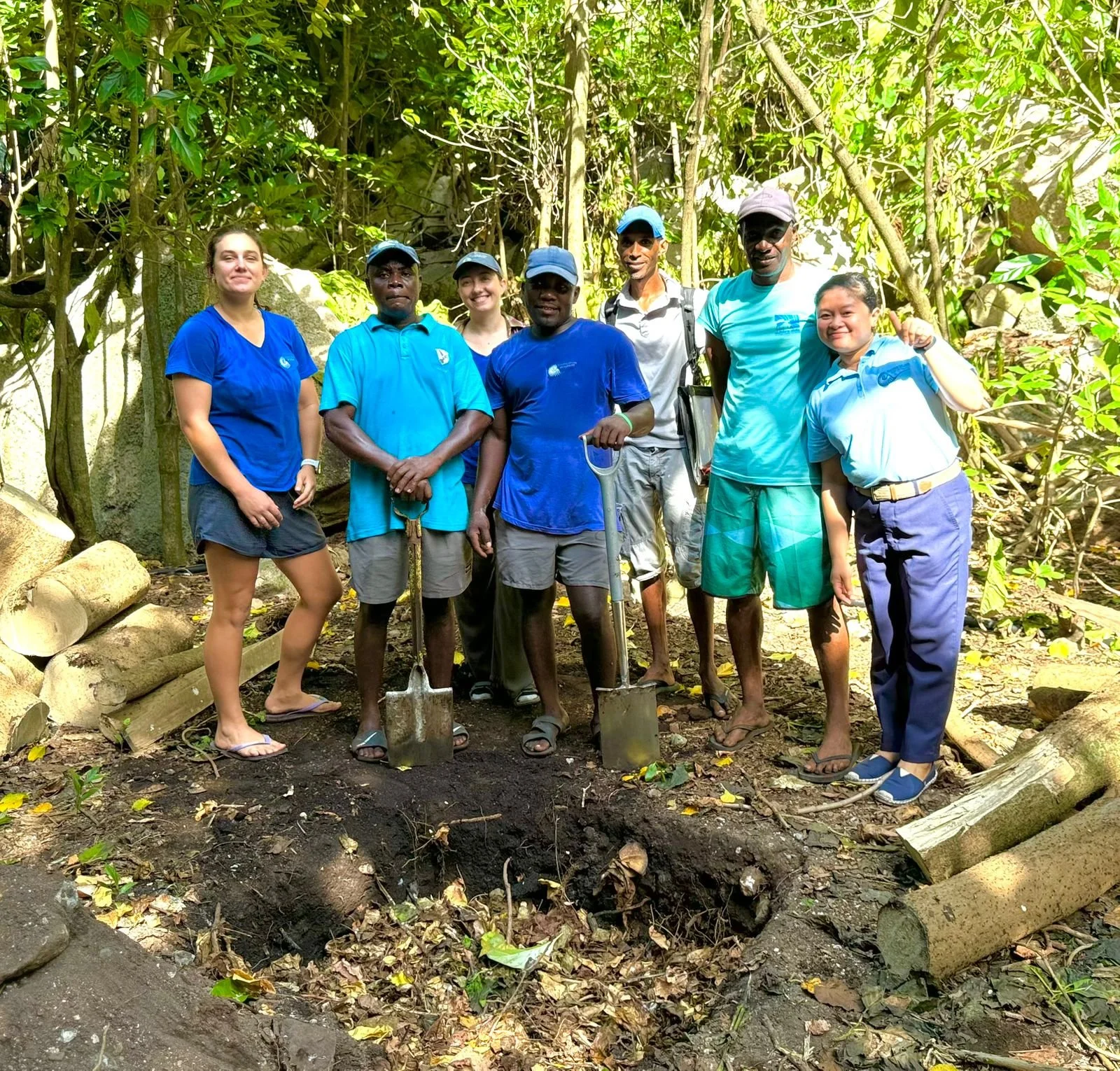
Restoring the natural forest by planting indigenous and endangered trees
Restoring the Land, One Tree at a Time
Conservation on Cousine Island extends well beyond fauna. The island operates a dedicated nursery that propagates indigenous plant species for reforestation. A solar power plant and rainwater capture system reduce the island’s environmental footprint, while a comprehensive recycling programme and marine restoration initiatives protect the surrounding reef and ocean.
Guests are invited to participate directly through indigenous tree planting, a hands-on experience that contributes to ongoing reforestation and gives visitors a tangible connection to the conservation mission. It is one thing to read about environmental stewardship. It is another to put a native seedling in the ground and know it will grow on this island long after you leave.

Counting turtle eggs to track nesting and hatching data
The People Behind the Mission
What makes Cousine Island’s conservation story exceptional is not just the results, but the people. The conservation officers are not distant researchers publishing papers in academic journals. They are islanders who live and work on Cousine year-round, who know every turtle track by sight and every magpie-robin by behaviour. Their commitment is quiet, consistent, and deeply personal.
For many guests, meeting the conservation team is a defining moment of their visit. Joining a guided nature walk led by someone who has spent years restoring this ecosystem adds a layer of meaning that no luxury amenity can replicate. It transforms a holiday into an education, and an education into a connection that lasts.
Experience It Yourself
Cousine Island’s conservation experiences are available to all guests year-round. Guided nature walks, bird watching, coral reef exploration, and indigenous tree planting require no booking — they are part of the fabric of every stay. For those visiting between September and April, turtle conservation experiences offer the chance to witness nesting and hatching firsthand.
To plan your visit, consult the Eco Calendar or contact the reservations team.